How AI Agents are changing the way we browse
When was the last time you actually enjoyed searching for something online?
You type “how to replace a broken tile” into Google. You wade through three ads disguised as tutorials. You scroll past 1,200 words of a blogger’s life story about their grandmother’s kitchen just to find the list of tools. You get a pop-up asking for your email. You get another pop-up saying BobVilla.com wants to know your location. No Bob, you can’t.
The internet has become a noisy, messy place for humans. But here is what’s interesting: The next version of the internet isn’t being built for us. It’s being built for agents.
The Tile Story
Last weekend, I needed to replace a cracked tile in the kitchen. In the old world (aka 2024), I would have spent an hour on YouTube and another hour wandering the aisles of Home Depot looking for “unsanded grout.”
This time, I just pulled out my phone and asked Gemini.
I didn’t search. I didn’t browse. I just said, “I need to fix a single floor tile. Tell me what tools and supplies I need.”
- It listed the exact tools I needed (chisel, grout, adhesive).
- It checked the inventory of my local Home Depot in real-time.
- It told me: “The grout is in Aisle 12, Bay 4. The chisel is in Aisle 14, Bay 2.”
- It could have even added all these items to my cart and started the purchase online for me.
Gemini didn’t use any browser automation for this. It used a backend protocol you probably haven’t heard of, because it launched two weeks ago.
The War of the Protocol
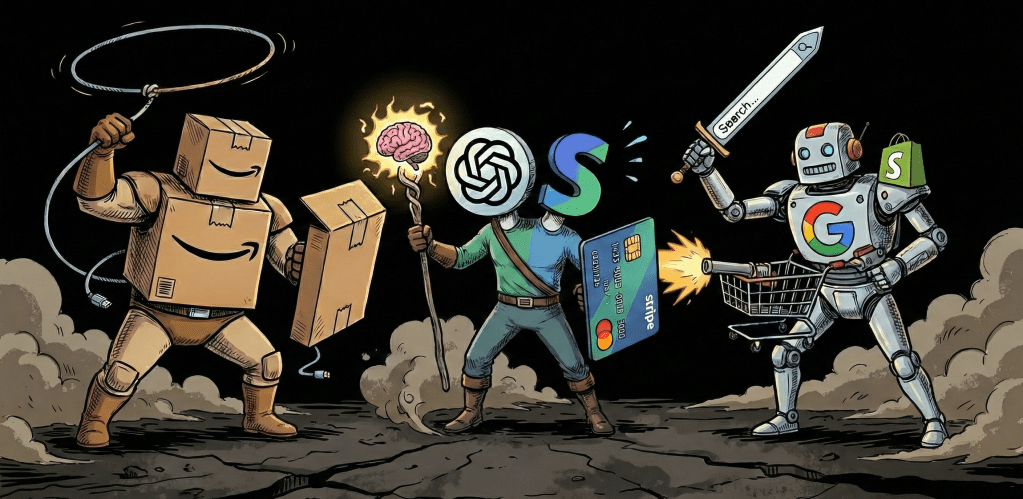
Right now, there is a massive infrastructure war happening behind the scenes to power these interactions. It’s a three-way standoff to determine how AI agents talk to websites.
- The Walled Garden (Amazon): Amazon wants you to use their “Buy for Me” agent. It’s proprietary, locked down, and only works well if you stay inside the Amazon ecosystem.
- ACP (Agentic Commerce Protocol): This is the OpenAI + Stripe alliance. They want a standard where ChatGPT can buy things for you directly in the chat.
- UCP (Universal Commerce Protocol): This is the newcomer, launched just a few weeks ago (Jan 11, 2026) by Google and Shopify.
Why UCP Matters: UCP is trying to be the “HTML for Commerce.” It allows an agent like Gemini to talk directly to a merchant’s inventory system without scraping the website. It finds the price, checks stock, and executes the order via API.
The “Third Audience”
Dries Buytaert (the creator of Drupal) recently coined a phrase I love: “The Third Audience.”
For 20 years, we built websites for two audiences:
- Humans (Visuals, CSS, Javascript)
- Search Crawlers (SEO, Meta tags)
Now, we have to build for AI Agents.
Dries actually ran an experiment on his own site where he created a Markdown version of his blog. No HTML, no CSS, just raw text. When he flipped the switch, he saw hundreds of hits from AI bots immediately. They prefer the raw data. They don’t want your beautiful React frontend. They want the bits.
The Stat: According to McKinsey’s latest report, “Agentic Commerce” is projected to be a $5 Trillion market by 2030.
What This Means for Engineers
If you are building web apps today, you need to stop thinking just about SEO and start thinking about AEO (Agent Engine Optimization).
- Hidden Prompts: Are you injecting context into your HTML that only an LLM can see?
- Raw Data Endpoints: Can an agent query your pricing without parsing a DOM?
- Protocol Support: Are you ready to implement UCP or ACP when your Product Manager asks for it next quarter?
The internet is changing. It’s becoming less like a library for humans and more like a database for robots.

Sources
- The “Third Audience” Concept: Dries Buytaert Blog
- McKinsey Report on Agentic Commerce: McKinsey Insights
- Google UCP Launch Details: Google Developers Blog (Jan 2026)
- Gartner Search Volume Prediction: Gartner Press Release
- Tavily (The Agent Search Engine): Tavily.com
 The Scrumgineer
Leave a comment